



With the recent pervasiveness of Artificial Intelligence (AI) in the world at large, tools like ChatGPT and Gemini have wormed their way into schools and the day-to-day lives of students and teachers alike. AI has become so present in our lives. While adaptation may be necessary, how we go about it is crucial for the safe development of students and the workload placed on teachers. I decided to interview teachers and students to gather their unique perspectives on AI in school.
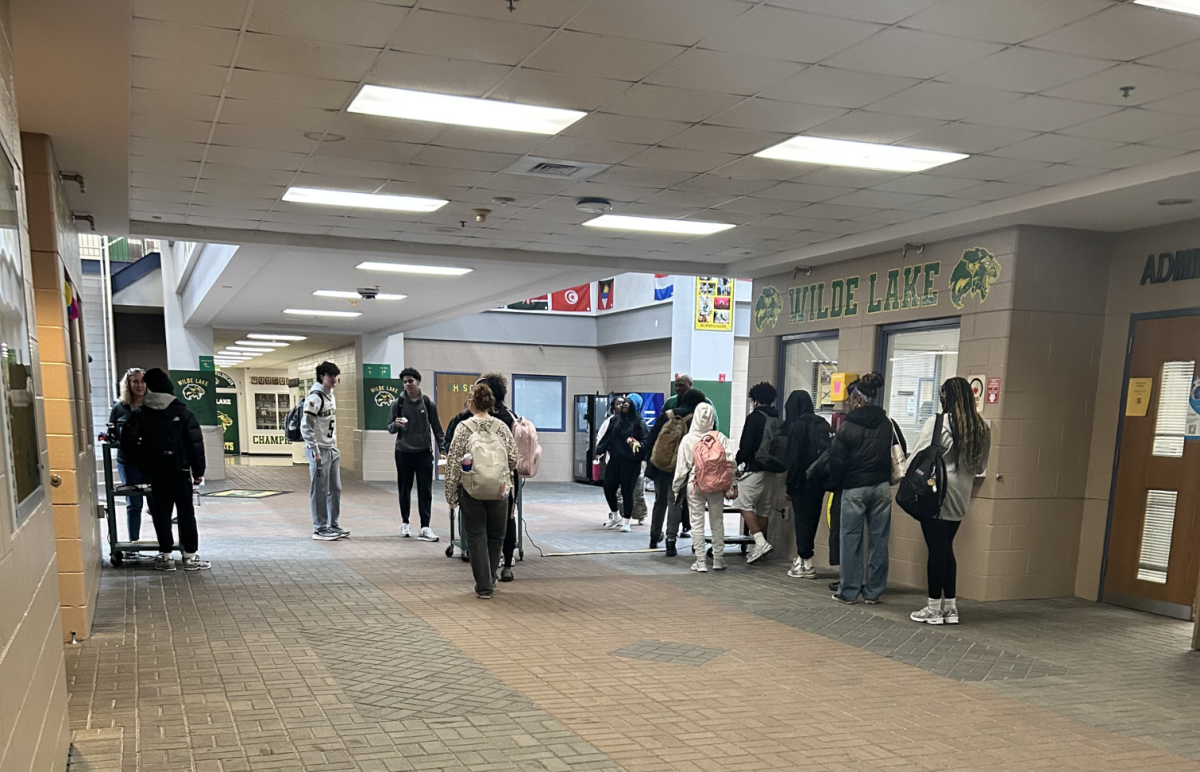
Teachers need to ensure that students are using technology safely for their benefit and not their detriment. Mrs. Henderson is a 9th- and 10th-grade English teacher at Wilde Lake, and her experience with AI in the classroom has not been reassuring. When asked whether AI could be a useful tool for students, she said, “I have more concerns than hopes. I think that students will be tempted to rely on it and become lazy.” Because she has had to adapt to this technology in her classroom, she changed once-convenient digital platforms such as Canvas or Google Docs to reduce AI use. “I have started requiring more handwritten assignments. They need to learn how to write before using [AI] in lieu of writing.” With all the concerns AI brings to educators, Mrs. Henderson worries that it is yet another burden added to an already undervalued profession, something I agree with. Teachers already have a lot on their plates, and dealing with AI should not have to be shoved onto their workload.
Students, on the other hand, feel that AI is helping them and do not share the same concerns as teachers. Jude Osman, a 10th-grader at the Lake says, “AI helps me because it helps you if you’re struggling with finding a precise answer.” He does not use AI excessively, mainly reviewing AI-generated overviews that appear in search results. However, he believes it has a place in schools. “I do tend to memorize, but AI is a good refresher if being reintroduced to material.” He also believes that “AI will get rid of untrustworthy sources,” a common belief among AI users.
In the Howard County Public School System, administrators believe adaptation to AI is necessary, which is why AI programs are beginning to roll out in schools. One of the Media Center specialists Ms. Palmateer, who will be responsible for implementing AI access for students, expressed some apprehension. “Students are going to have access to Google Gemini, and how you use it will be up to your teachers. My suggestion is that they keep assignments AI-free. We want you to learn. Your brains are still developing… to learn, AI is not the best tool.” While AI will be moderated, Ms. Palmateer believes it is not an appropriate tool for students in a school setting. She notes that while AI has its place in society at large, such as in doctors’ offices, “Students want things done quickly, so AI is an easy answer. But there’s no learning when someone does that. It can be a useful tool; I just don’t think it’s appropriate for the school setting.”
Ms. Palmateer also believes it is difficult to trust students with AI, but she shared a personal example of what she considers an ideal use of AI in a professional setting. “I had to write a letter to someone and didn’t quite know how to phrase it, so I put my prompt into AI. What I got back sounded too flowery and didn’t sound like me. So I took the basic idea, rewrote it, and made up my own mind. Is that what students will do? Probably not, because it takes a lot more time.” While she still believes AI will be difficult to integrate effectively in schools, she suggests that using it as a starting point, similar to using Wikipedia to search for sources, could be a productive approach. She concluded by saying, “Are we ever going to be totally AI-free in the education setting? No. Are there times when you’re in a pinch? I’ve seen students use it in that regard.”
Overall, I agree with teachers’ judgment regarding AI models. Students need to develop core learning skills before relying on artificial intelligence. However, with the uncertainty surrounding AI’s rapid advancement, students and teachers may be among the first groups required to adapt. On a fundamental level, AI changes how we perceive and use information. If students are eventually given broad access to AI, it must be used carefully to ensure learning still comes before reliance on new technology.